Originally written as a blog post for the Politics and Artificial Intelligence course at the University of Amsterdam.
The night of September 26, 1983, could have marked the end of humanity. Lieutenant Colonel Stanislav Petrov, stationed in a bunker near Moscow, faced a decision that bore the weight of the world. The early-warning system reported a U.S. missile launch, a scenario poised to trigger the Mutual Assured Destruction (MAD) doctrine, potentially annihilating the United States, the Soviet Union, and possibly the entire world. In the crisis night, Petrov had little time to think. Five minutes, to be precise. He judged the reports to be a false alarm and decided to dismiss them, relying on judgment rather than protocol. This incident, emblematic of Cold War tensions, also serves as a backdrop for discussing the transformative impact of Artificial Intelligence (AI) on military dynamics and inter-state relations.
In those same years, war games and world-war movies expressed the anxieties of an era marked by the exacerbation of international tensions and the terror of a third-world conflict that would lead to the extinction of the human race. Films like “WarGames” became famous. The movie told the story of David Lightman, a young and highly skilled hacker who managed to break into a supercomputer that the U.S. high command had entrusted with the control of missiles equipped with atomic warheads. The supercomputer was called Joshua, a very powerful machine capable of simulating multiple scenarios of a thermonuclear war based on the strategic principles underlying games like chess and poker, and trained by playing against itself.
The emergence of AI marks the beginning of the autonomous warfare era, in which humans are unable to match the speed or scale of judgements made by unmanned systems and AI-driven algorithms in real time. This capability is a major change from conventional combat, where the limiting factor has always been human decision-making, even with the aid of technology. AI-controlled cyberattacks, AI-driven disinformation campaigns, and autonomous drones bring a never-before-seen degree of speed and unpredictability to military planning. Unlike during the Cold War, however, wouldn’t the doctrine of Mutual Assured Destruction and the war principle of containment apply in relations between humanity and artificial intelligence?
If we think about all the cyber technologies once used for warfare, those technologies were highly centralized, financed with huge public investments, and regulated internationally by a logic of deterrence and retaliation. Instead, artificial intelligence is born controlled by a few subjects in Silicon Valley but ends up dispersing into thousands of streams. The multiple potentially ruinous uses cannot be contained unless we imagine a society of pervasive and permanent surveillance. AI technology also democratizes military power in ways that blur the lines between state and non-state actors. With AI, smaller nations or even non-state groups can potentially access and deploy sophisticated military capabilities that were once the exclusive domain of superpowers. This shift could lead to a more multipolar world where power is more evenly distributed, but also one where the barriers to initiating conflict are lower, and the risks of escalation and non-containment are higher.
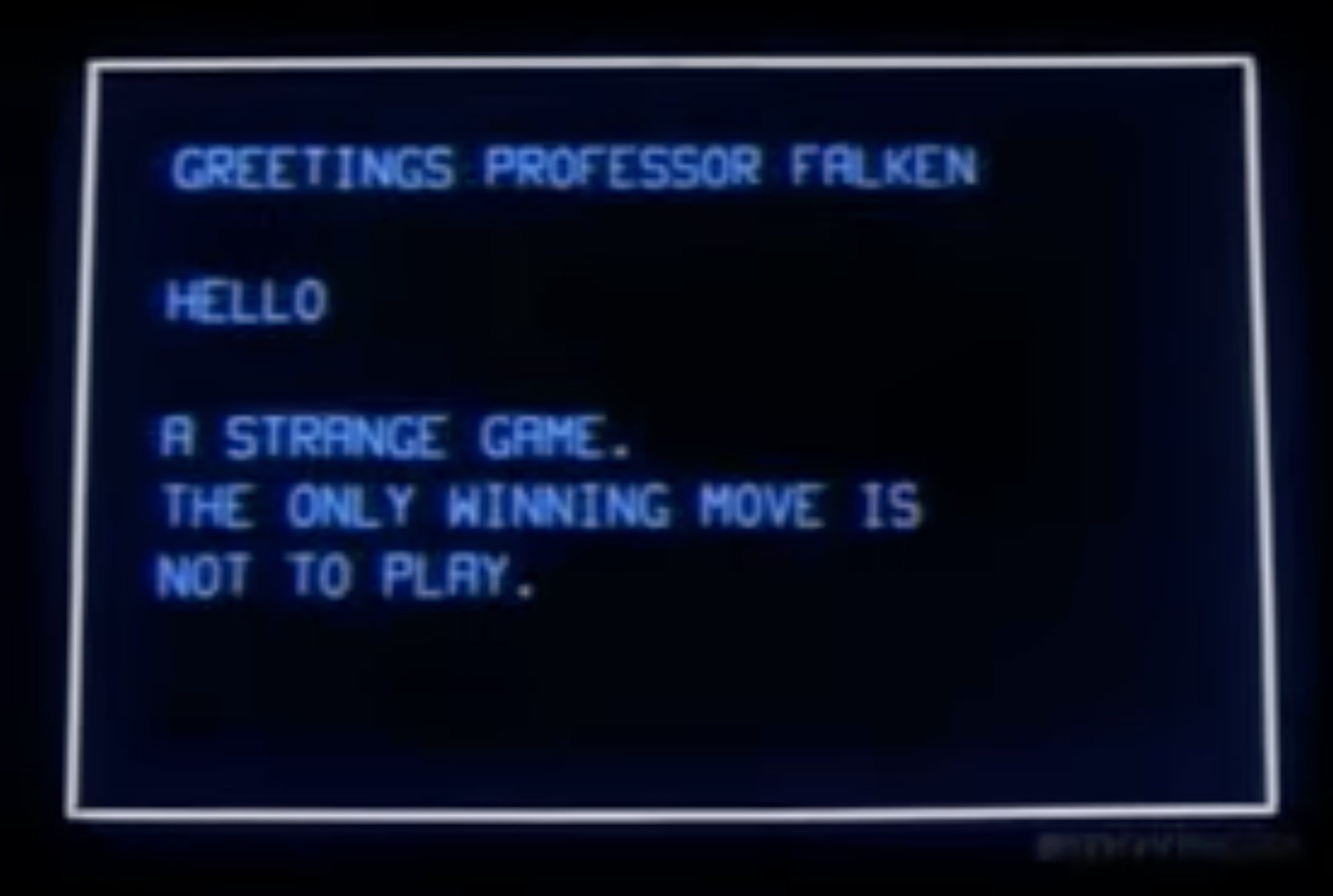
The end of WarGames is quite remarkable; the supercomputer suggests that “the only winning move is not to play.”
AI-driven systems could worsen wars in unexpected ways, since their algorithms might not prioritise political ties or human lives in the same manner as us. Artificial intelligence systems run the possibility of misinterpreting data or acting on erroneous information based on algorithms. Sometimes the best decision might not be the most efficient: think about what would have happened if, instead of General Petrov, an automated system of detection and alarm had managed the situation. Consequences would have been catastrophic. It might have resulted in unintentional conflict, or even worse, the end of humanity. His decision underscores the critical role of human oversight in the nuclear age.
For this reason, the international community must create norms and agreements to control the use of AI in military circumstances. Given the potential of these technologies, theories and doctrines that have shaped military thought for decades (like MAD or containment) may need to be reviewed in light of AI development. AI represents a paradigm shift that challenges existing doctrines, redistributes power, and introduces new ethical and strategic dilemmas. It is relevant that politics intervenes to address those critical dilemmas, which might have inter-state implications. The changes AI brings to the military field are not just incremental; they are transformative, fundamentally altering the field of international security.